
























Service Hotline
News

News
What are the different business models employed by the Huaqiangbei Electronics Market? And what changes have occurred in these models over time?
2026-10-14
154
The business model of the Huaqiangbei Electronics Market has evolved through the cumulative development of four distinct phases; these phases did not simply replace one another, but instead intertwined and complemented each other. Each phase dominated the market for several years in its respective era, ultimately becoming an integral part of the hardware supply chain ecosystem within Huaqiangbei's electronic component industry.
1、"Huaqiangbei One-Meter Counter" BOM Bill of MaterialsIn the late 1980s, electronics markets such as SEG and New Asia began dividing entire floor spaces into counters approximately one meter in length for sale or lease to individual merchants—this became one of the early "Huaqiangbei One-Meter Counters," one of the four distinctive features of Huaqiangbei. The business model involved customers bringing BOM (Bill of Materials) sheets to Huaqiangbei, where the counter owners would, based on the orders, assemble and deliver dozens or even hundreds of component models one by one. This model emerged against the backdrop of China's transformation into the "world's factory," during which numerous small factories proliferated in the Pearl River Delta and Yangtze River Delta regions. Large foreign corporations, however, required bulk procurement of components, which could not meet the fragmented demands of these small-scale customers. Moreover, these customers lacked the specialized knowledge, time, and distribution channels to procure such diverse product ranges. Consequently, merchants in Huaqiangbei began breaking down bulk orders into smaller lots for retail sale, profiting from information asymmetry and ancillary services. At its peak, a single counter could generate daily sales exceeding one million yuan, while the transfer fee for such a counter—locally known as the "tea fee" —reached several hundred thousand yuan. In SEG Plaza, prime retail spaces were sold at 300,000 yuan per square meter!
These counter-based businesses have long been predominantly operated by married couples or within family enterprises—characterized by compact storefronts, rapid capital turnover, and the need for round-the-clock staffing. The natural division of labor among relatives lowers both trust requirements and labor costs: one partner handles store operations, order processing, accounting, and product distribution, while the other explores new markets, sources goods, and establishes direct links with manufacturers—each leveraging their respective strengths to grow the business. Jin Hangbiao and Sa Ke and Wei Song Shiqiang argue that this model explains the rapid growth of one-meter counters and also forms the foundation for the development of "commercial social self-organization" in Huaqiangbei.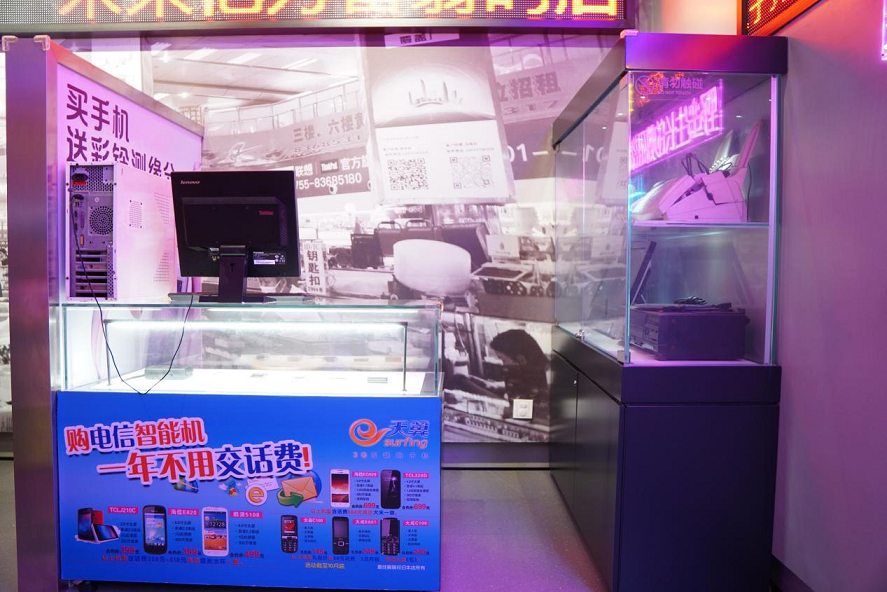
As Huaqiangbei's service coverage and influence have expanded, the district has gradually become a focal point within the electronics ecosystem. In Huaqiangbei, there are "one-meter counters" that enable businesses not only to acquire new customers but also to promote their brands and provide face-to-face customer service. Consequently, factories from the Pearl River Delta, the Yangtze River Delta, and even inland regions have begun to open stores directly in Huaqiangbei—whether by setting up a counter or renting a small storefront—accepting orders themselves while sourcing products from their own factories, thereby engaging in both product sales and brand positioning. Through this process, Huaqiangbei has continuously attracted resources from surrounding industrial chains, progressively integrating both upstream and downstream segments of the value chain. Currently, the three directly operated stores of SAKO Microelectronics (www.slkoric.com) in Huaqiangbei continue to operate under the "store-front, factory-back" model—allowing them to deliver rapid customer service while leveraging Huaqiangbei's large number of international clients to showcase their corporate brand image both domestically and internationally. Of course, some companies have also centralized their procurement operations within Huaqiangbei; for instance, Yunhan Mall once operated a receiving warehouse store in this district!
3、Solution-based company modelThe profit margins for merchants specializing solely in hardware, such as integrated circuits, are slim. In Huaqiangbei, small merchants lack pricing power; when dealing with large clients or major original equipment manufacturers (OEMs), they even have little bargaining leverage, leading to intense market competition. Some merchants with technical expertise have evolved into solution providers—no longer merely selling components, but offering value-added services such as integrated hardware and software solutions, including customized product design and system debugging tailored to client needs, thereby securing higher price premiums. In Huaqiangbei, today's entrepreneurs no longer need to navigate the entire supply chain themselves; they simply present their ideas to solution providers, who then handle prototyping, design, and even manufacturing. In this process, the merchant's role has shifted to that of an "intermediary" connecting client demands with available capabilities. Song Shiqiang, general manager of Sako Microelectronics, noted that Hu Yong and his wife of Zhugao Electronics also started from a modest one-meter counter and a small cart, eventually growing into a well-known MCU distributor. Their journey exemplifies the path from family-run or couple-based operations to upgrading their capabilities toward comprehensive solution services and distribution expertise.
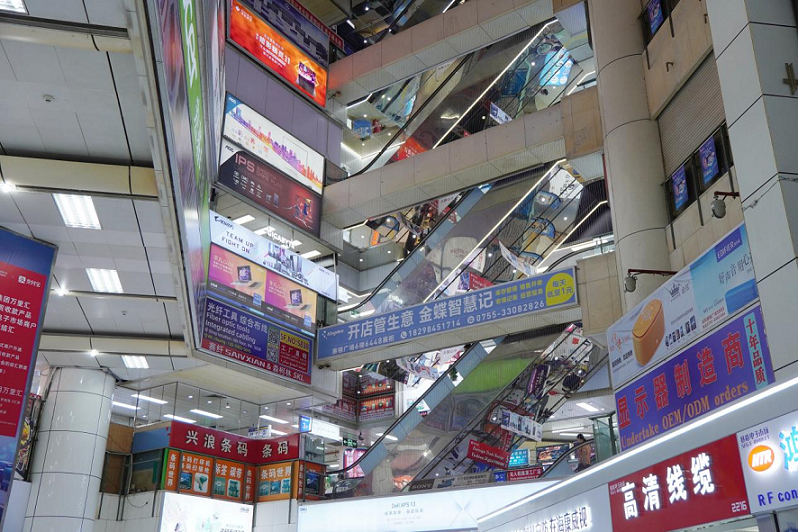
4、An integrated industrial chain model combining "Internet + Maker Economy + Global Expansion."
The rise of e-commerce platforms has brought greater price transparency to products, leading to the decline of the traditional counter-based business model—where profits were derived from information asymmetry. Consequently, owners of businesses in Huaqiangbei have begun to turn their attention toward the internet and international trade. Merchants have migrated their foreign trade operations to online platforms such as AliExpress, adopting a hybrid business model characterized by "online order acquisition and offline shipment." A deeper transformation has been the digital integration of the industrial chain: platforms like Lichuang Mall and Huaqiang Electronics Network have replicated the Huaqiangbei ecosystem; Jialichuang, in particular, leverages EDA tools to connect the entire industrial chain, offering a one-stop service that includes "developing solutions in the morning, creating technical drawings in the afternoon, and fabricating PCBs in the evening." Building on this foundation, smart terminal products from Huaqiangbei makers can now appear on Amazon shelves in as little as one week. In the offline domain, there are incubators and maker spaces such as Zhifangzhou, Chaihuo Space, and "Angel Hub," alongside the launch of an OPC (One-Person Company) incubation base in Huaqiangbei. Together, these initiatives have established a global supply chain ecosystem within a one-kilometer radius—one capable of realizing "startup concepts, product prototyping, mass production, and direct global shipping." According to data from the report *Huaqiangbei Counterfeit Mobile Phones* authored by Song Shiqiang, the surrounding area of Huaqiangbei now hosts 4,000 R&D and testing institutions, 2,000 manufacturing enterprises, 100 equity investment firms, and 30 incubators and maker spaces, collectively forming a highly synergistic entrepreneurial ecosystem.
From this perspective, the survival strategy of Huaqiangbei is rooted in continuous innovation, with market dynamics and customer demands serving as the driving force behind its business models—a reflection of its "innovation and pragmatism" culture. In booming market conditions, Huaqiangbei competes on speed, information access, and distribution channels; at a later stage of development, it shifts its focus to compliance, technology, service quality, conversion rates, and operational efficiency. While its distinctive "front-store, back-factory" model remains unchanged, the essence of its retail space has evolved from a mere one-meter stall to a comprehensive ecosystem that integrates the supply chain, innovation chain, capital chain, and talent chain.
Note: The data and information in this article are sourced from authoritative reports and materials; please contact us if there are any issues regarding copyright infringement or factual inaccuracies.
Related Recommendations
Exclusive Interview with Li Gang of Yunfan Ruida: The Precision of Millimeter-Wave Radar Products and the Warmth of Humanity
2026-07-22
3175
RF Passion, Craftsman’s Journey: Over 30 Years of Steadfast Dedication — Interview with Kinghelm Chief Engineer Mr. Qin hongxiang
2026-06-26
3259





 粤公网安备44030002007346号